

Could an online peptide listing tell you whether a vial contains the right substance, concentration, or sterile ingredients? The risks of buying peptides online start with that uncertainty. A polished website and confident seller claims can’t verify what’s in a product or whether it’s suitable for you.
It’s understandable to feel unsure when online discussions mix promising testimonials with conflicting claims about safety and FDA status. But a product labeled “research use only” isn’t the same as an FDA-approved medication or a prescription compounded for a patient. Those categories have different oversight and limitations, and a label alone can’t establish that a product is safe for human use.
This article explains warning signs to take seriously, how approved, compounded, and investigational peptides differ, and what to discuss before considering treatment. At LexMed & Wellness, a Lexington, Kentucky clinic, peptide questions can be discussed with a provider in the context of your health history, medications, goals, and potential risks, rather than a seller’s promises.
Key Takeaways
- The risks of buying peptides online can involve product identity, purity, concentration, storage, and limited oversight.
- Look beyond seller language: identify the exact peptide and check its current regulatory status before trusting claims.
- Evidence and treatment options differ by peptide, so an online claim isn’t proof of safety or benefit.
- Before considering a peptide, prepare to discuss your goals, health history, medications, and potential risks with a qualified healthcare professional.
What does buying peptides online mean, and why does product status matter?
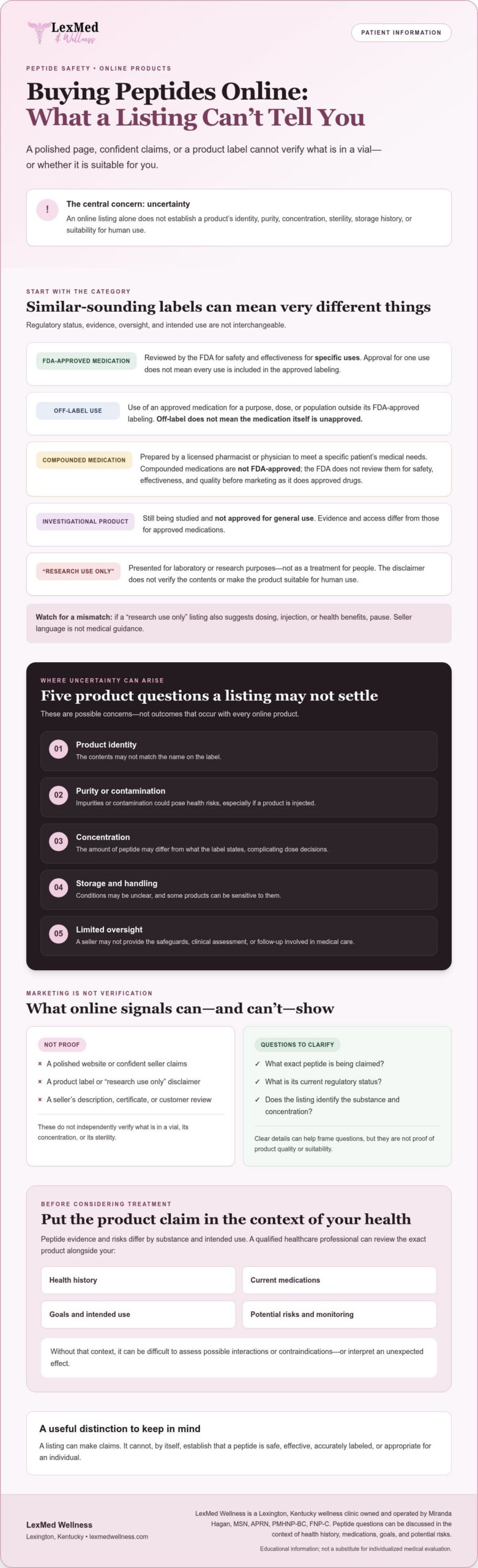
Buying peptides online can mean ordering products with very different intended uses and regulatory statuses. Peptides are short chains of amino acids, the building blocks of proteins. The term describes a broad group of substances, not a single treatment. What are peptides offers a basic scientific overview. An online label alone doesn’t verify a product’s identity, quality, or suitability for you.
An FDA-approved medication has been reviewed for safety and effectiveness for specific uses. “Off-label” describes use of an approved medication for a purpose, dose, or population not included in its FDA-approved labeling. It doesn’t mean the medication itself is unapproved. An investigational product is still being studied and hasn’t been approved for general use. These distinctions matter because evidence, oversight, and access differ.
Compounded medication: A medication prepared by a licensed pharmacist or physician by combining, mixing, or altering ingredients to meet a specific patient’s medical needs. Compounded medications are not FDA-approved, and FDA doesn’t review them for safety, effectiveness, and quality before they’re marketed as it does approved drugs. Compounding and FDA approval are separate regulatory concepts.
What does research-use-only mean on an online listing?
“Research use only” indicates that a product is presented for laboratory or research purposes, not as a treatment for people. For instance, laboratory facilities acquiring wholesale research peptides australia or specialized chemical compounds utilize them strictly for laboratory benchwork rather than clinical consumption. That disclaimer doesn’t prove what the product contains or make it suitable for human use. If a listing also suggests dosing, injection, or health benefits, pause rather than treating those claims as medical guidance. A label can’t replace verified product status and clinical assessment.
Is a compounded peptide the same as an FDA-approved drug?
No. Compounding may be used to prepare a medication for a specific patient, but it doesn’t grant FDA approval or establish that a particular peptide is eligible for compounding. Rules and availability can vary by substance and change over time. Check current FDA information and discuss the exact product with a qualified healthcare professional before considering it.
What are the main risks of buying peptides online?
The risks of buying peptides online vary by product, but uncertainty about what’s in a vial can make both use and medical decision-making less predictable. Possible concerns include:
- Product identity: The contents may not match the name on the label.
- Purity or contamination: Impurities or contamination could pose health risks, especially if a product is injected.
- Concentration: The amount of peptide may differ from what the label states, complicating dose decisions.
- Storage: Handling or storage conditions may be unclear, and some products can be sensitive to them.
- Lack of oversight: A seller may not provide the safeguards, clinical assessment, or follow-up involved in medical care.
These are possible risks, not outcomes that occur with every online product. But when identity, concentration, or storage is uncertain, it’s harder to know what a person has been exposed to or interpret an unexpected effect. Harvard Health Publishing outlines potential peptide safety concerns, including contamination and limited evidence for some uses.
Can an online label prove what is in the vial?
No. A seller’s description, certificate, or customer review isn’t the same as independent verification of a vial’s contents, concentration, or sterility. That doesn’t mean every online product is counterfeit or contaminated. It means the listing alone can’t reliably settle those questions. If you’re evaluating a listing, note whether it clearly identifies the substance and concentration, but don’t treat those details as proof of product quality.
Why does medical oversight matter when using peptides?
Peptide risks and evidence differ by substance and intended use. A healthcare professional can review your health history, current medications, possible interactions or contraindications, and what monitoring may be needed. Without that context, an effect or side effect may be difficult to assess. Patients in Lexington, Georgetown, Nicholasville, Louisville, Winchester, and Danville can discuss these questions through provider-led peptide care at LexMed Wellness, without assuming a particular product is suitable.
How can you assess an online peptide claim without mistaking marketing for proof?
Pause before ordering. Write down the exact substance named, the intended use, and the claims the seller makes. Then check the substance’s current regulatory status through FDA information. A product label, seller certificate, testimonial, or “research use only” disclaimer doesn’t establish that it’s safe or suitable for you. The Health Canada warning on serious health risks of unauthorized peptides offers another reason to take unverified claims seriously. For broader context about treatment questions, see LexMed Wellness’s peptide therapy guide.
Which seller claims should prompt closer scrutiny?
Be wary of guaranteed results, broad claims to cure disease, or language that dismisses meaningful risks. Also pause if the listing doesn’t clearly identify the ingredient, concentration, or intended use. Missing details are unresolved questions, not proof of misconduct, but they make it harder to judge what’s being offered. The risks of buying peptides online can’t be assessed from persuasive marketing alone.
What should you bring to a clinical conversation?
Bring the product name, label, seller claims, and a list of your medications, health conditions, and goals. If you have product information such as a certificate or storage instructions, bring that too. A clear discussion can address:
- What evidence supports this peptide for the intended use?
- What is its regulatory status, and what does that status mean?
- What alternatives, potential interactions, or contraindications should be considered?
- What monitoring would be needed, and is this treatment suitable for me?
At LexMed Wellness in Lexington, Kentucky, a provider-led conversation can start with your health history and goals rather than a product selected online. Discuss peptide questions with LexMed Wellness before deciding whether to pursue treatment.
What is a safer next step than self-starting peptides bought online?
Start with your health goals, medical history, medications, and relevant clinical factors, not with a product already chosen from an online listing. Evidence and treatment options vary by peptide and intended use. Some peptides have established medical uses, while others are investigational or supported by limited evidence. A discussion can help clarify what is known, what remains uncertain, and whether a treatment is suitable to consider.
What can a provider-led evaluation clarify?
A provider-led evaluation connects the claim to your specific health question. Your history and medications help identify potential interactions, contraindications, and factors that could affect treatment decisions. The conversation can also distinguish evidence for a particular use from claims made in marketing, and review alternatives and any monitoring that may be relevant. No single peptide is right for everyone, and an evaluation doesn’t guarantee that treatment will be recommended.
LexMed Wellness is a Lexington, Kentucky clinic offering peptide therapy. For broader context about the practice’s approach, explore peptide therapy at LexMed Wellness.
When should you seek medical advice after using an online product?
Contact a qualified healthcare professional promptly if you experience unexpected symptoms or have concerns after using a product. Share the label and any available product information, along with when and how you used it. If symptoms are severe or feel urgent, seek emergency medical care rather than waiting for a routine appointment.
If you’re weighing a peptide claim or want to discuss your goals and health history, discuss peptide therapy with LexMed Wellness.
Make your next peptide decision an informed one
The risks of buying peptides online often come down to unanswered questions: what a product contains, how it’s regulated, and whether it fits your health needs. A label, testimonial, or seller’s promise can’t replace reliable evidence or an assessment of your medical history and medications. Peptide evidence and treatment options vary, so a product that’s marketed confidently isn’t automatically established or suitable.
A safer approach is to pause, check what you can through current FDA information, and discuss the specific product and your goals with a qualified healthcare professional. If you’ve already used an online product and have unexpected symptoms, seek medical advice. For severe or urgent symptoms, contact emergency services.
LexMed Wellness offers peptide therapy through provider-led care at its clinic in Lexington, Kentucky. A conversation can help you consider questions about evidence, risks, and options without assuming a particular peptide is right for you. Contact LexMed Wellness to discuss peptide therapy and take a thoughtful next step toward care that reflects your health needs.
Frequently Asked Questions
Is it safe to buy peptides online?
Buying peptides online doesn’t by itself confirm that a product is safe. The risks of buying peptides online depend on the specific substance and circumstances, and a listing, review, or seller’s assurance can’t verify identity, quality, storage, or suitability. Before considering use, discuss the exact product and its claims with a qualified healthcare professional who can review your health history and medications.
How can I tell whether an online peptide product is legitimate?
A polished website, customer reviews, or a seller-provided certificate can’t independently establish a product’s quality or suitability. Identify the exact substance and intended use, then compare its claims with current authoritative information, including FDA resources where relevant. If the ingredients, concentration, or regulatory status remain unclear, treat those details as unanswered questions rather than assuming the listing proves legitimacy.
Are compounded peptides FDA-approved?
No. Compounded medications are not FDA-approved, even when prescribed or prepared in a healthcare setting. Compounding and FDA approval are different regulatory concepts, and the status of specific products can depend on the substance and current requirements. Check current FDA information and discuss the exact product with a qualified healthcare professional before considering use. A prescription alone doesn’t mean a compounded medication is FDA-approved.
What should I do if I already bought peptides online?
Keep the packaging and product information, and share the label, product name, seller claims, and any details about use with a qualified healthcare professional. Don’t rely on the seller to assess symptoms or possible medication interactions. If you develop unexpected symptoms, seek medical guidance promptly. For severe or urgent symptoms, seek emergency care rather than waiting for a routine appointment.
Can a clinician help me decide whether peptide therapy is appropriate?
Yes. A clinician can review your health history, medications, goals, and the evidence and regulatory status of the specific therapy. This can clarify potential risks, limitations, and alternatives, but doesn’t guarantee that a treatment will be suitable or available. LexMed Wellness offers peptide therapy in Lexington, Kentucky. Patients in Lexington, Georgetown, Nicholasville, Winchester, Danville, and Louisville can discuss their questions with the practice.