

Changes in your body and mind can be unsettling, especially when they affect your energy, mood, and overall sense of well-being. For many men and women, these shifts are tied to natural fluctuations and declines in hormone levels. If you’ve been searching for clear, evidence-based information, you’ve likely come across the term hormone replacement therapy (HRT).
But what is hormone replacement therapy, really? It’s a medical treatment designed to supplement hormones that your body is no longer producing in sufficient amounts. The goal is not to reverse aging or restore hormone levels to what they were at age 20, but to alleviate disruptive symptoms and improve your quality of life through a carefully managed, individualized plan. This guide explains the fundamentals of HRT, who might be a candidate, and what to expect from a professional evaluation in Lexington, KY.
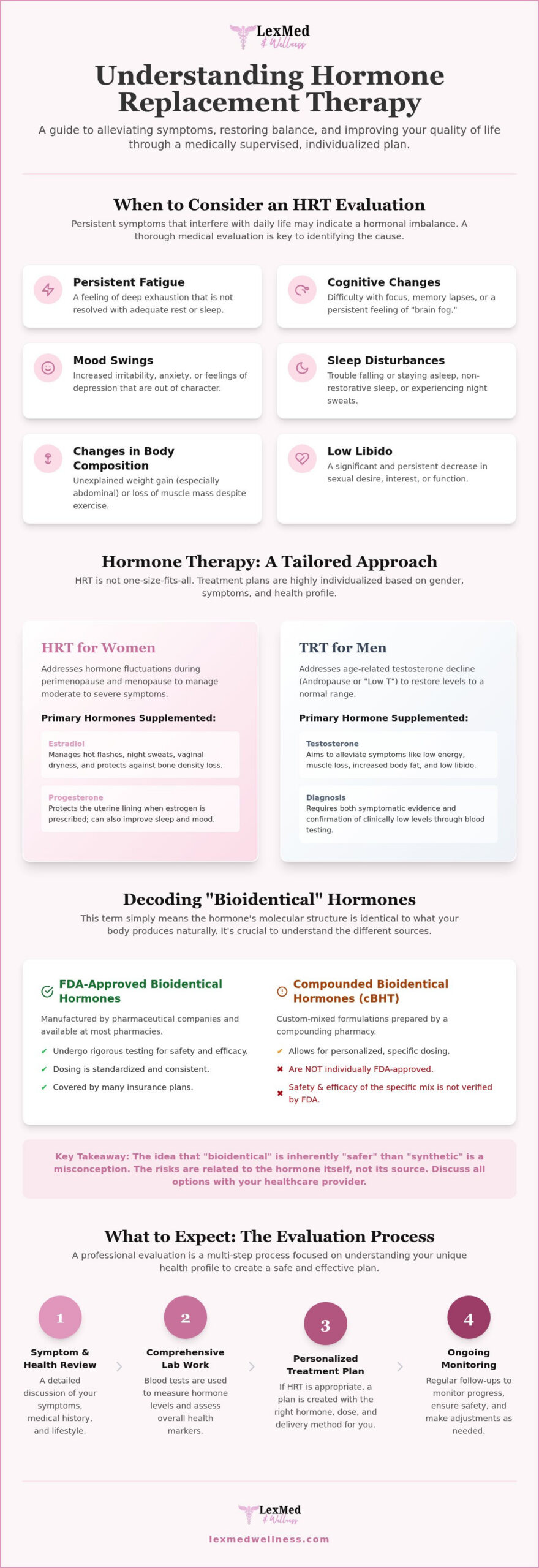
What Symptoms Can Lead to an HRT Evaluation?
While many people associate hormone changes strictly with menopause, the reality is that both men and women can experience symptoms of hormonal imbalance at various stages of life. These symptoms are often nonspecific and can be attributed to stress or aging, which is why a thorough medical evaluation is so important. A conversation about HRT often begins when patients report persistent symptoms that interfere with their daily lives.
Common concerns that may prompt an evaluation include:
- Persistent Fatigue: A feeling of exhaustion that isn’t resolved with adequate sleep.
- Cognitive Changes: Difficulty with focus, memory lapses, or “brain fog.”
- Mood Swings: Increased irritability, anxiety, or feelings of depression.
- Sleep Disturbances: Trouble falling asleep, staying asleep, or experiencing non-restorative sleep, including night sweats.
- Changes in Body Composition: Unexplained weight gain, particularly around the abdomen, or a noticeable loss of muscle mass despite consistent exercise.
- Low Libido: A significant decrease in sexual desire or function.
- Physical Discomfort: Symptoms like joint pain, dry skin, or hair thinning.
It’s important to remember that these symptoms can have many potential causes. A comprehensive evaluation, including a detailed health history and appropriate lab work, is necessary to determine if a hormonal imbalance is a contributing factor.
HRT for Women: Perimenopause and Menopause
For women, the conversation around hormone therapy most often centers on perimenopause and menopause. Perimenopause is the transitional period leading up to menopause, which can last for several years. During this time, the ovaries’ production of estrogen and progesterone becomes irregular, leading to a wide range of symptoms. Menopause is officially diagnosed after a woman has gone 12 consecutive months without a menstrual period.
The primary hormones addressed in menopause hormone therapy are:
- Estradiol: The main form of estrogen in the female body. Declining estradiol is responsible for many of the most well-known menopausal symptoms, including hot flashes, night sweats, vaginal dryness, and bone density loss.
- Progesterone: This hormone helps regulate the menstrual cycle and supports pregnancy. In hormone therapy, progesterone is prescribed for women who still have a uterus to protect the uterine lining (endometrium) from the effects of estrogen. It can also have a positive impact on sleep and mood.
Women’s hormone therapy is designed to supplement these declining hormones to manage moderate to severe symptoms. Treatment is highly individualized, with the type of hormone, dosage, and delivery method (pills, patches, gels, or creams) chosen based on a woman’s specific symptoms, health profile, and preferences.
Testosterone Replacement Therapy for Men
Men also experience an age-related decline in hormones, primarily testosterone. This gradual decrease is sometimes referred to as andropause or “low T.” Unlike the relatively rapid hormonal shift of menopause in women, testosterone decline in men is typically a much slower process.
However, when levels fall significantly, it can lead to noticeable symptoms. Testosterone replacement therapy (TRT) may be considered for men who have clinically low testosterone levels accompanied by symptoms such as:
- Decreased energy and motivation
- Loss of muscle mass and strength
- Increased body fat, especially in the abdominal area
- Reduced libido and erectile dysfunction
- Mood changes, including irritability or depression
- Difficulty concentrating
The goal of TRT is to restore testosterone levels to a normal physiologic range to help alleviate these symptoms. As with women’s HRT, a diagnosis of low testosterone requires both symptomatic evidence and confirmation through blood testing. Treatment plans are tailored to the individual and involve ongoing monitoring to ensure safety and effectiveness.
Bioidentical Hormones: What the Term Actually Means
The term “bioidentical” often causes confusion. In simple terms, a bioidentical hormone is a substance that is structurally identical to the hormones naturally produced by the human body, like estradiol or progesterone. Many people are surprised to learn that numerous FDA-approved hormone therapy products prescribed in conventional medicine are, in fact, bioidentical. These products are manufactured by pharmaceutical companies and have undergone rigorous testing for safety, efficacy, and consistent dosing.
There is another category often associated with the term: compounded bioidentical hormone therapy (cBHT). These are custom-mixed formulations prepared by a compounding pharmacy based on a provider’s prescription. While this allows for personalized dosing, it’s crucial to understand that these specific compounded preparations are not FDA-approved. The FDA does not verify their safety or effectiveness in the same way it does for manufactured pharmaceuticals.
The idea that bioidentical hormones are inherently “safer” or “more natural” than non-bioidentical (synthetic) hormones is a common misconception. The risks associated with hormone therapy are related to the hormone itself, not necessarily its source. A decision to use an FDA-approved product or a compounded formulation should be made after a detailed discussion with your healthcare provider about the potential benefits and risks of each approach for your specific situation.
What Labs Are Checked Before HRT?
A responsible approach to hormone replacement therapy always begins with a comprehensive health assessment, which includes laboratory testing. Blood work provides a crucial baseline and helps your provider understand your unique hormonal and metabolic profile. However, treatment decisions are never based on lab numbers alone; they are always interpreted in the context of your symptoms, health history, and treatment goals.
A typical hormone panel may include:
- For Women: Follicle-Stimulating Hormone (FSH), Estradiol, and Testosterone. Progesterone levels may also be checked.
- For Men: Total and Free Testosterone, Sex Hormone-Binding Globulin (SHBG), and Estradiol.
- For Both: A complete thyroid panel (TSH, Free T3, Free T4), a Complete Blood Count (CBC), a Comprehensive Metabolic Panel (CMP), and markers for cardiovascular risk like a lipid panel.
This comprehensive testing ensures your provider has a clear picture of your overall health before recommending any treatment and helps rule out other medical conditions that could be causing your symptoms.
Is Hormone Replacement Therapy Safe?
This is one of the most important questions patients ask. The safety of HRT has been a topic of much debate, largely due to findings from the Women’s Health Initiative (WHI) study in the early 2000s. However, our understanding has evolved significantly since then. Re-analysis of the WHI data and subsequent research have shown that the risks of HRT depend heavily on the individual’s age, time since menopause, and personal health history.
According to leading medical organizations like The Menopause Society (formerly the North American Menopause Society) and the American College of Obstetricians and Gynecologists (ACOG), for many healthy women experiencing bothersome symptoms, the benefits of starting hormone therapy within 10 years of menopause or before age 60 generally outweigh the risks.
Safety is maximized by following these principles:
- Thorough Screening: HRT is not for everyone. A detailed review of your personal and family medical history (including history of breast cancer, blood clots, heart disease, or stroke) is essential to identify any contraindications.
- Individualized Treatment: The right type, dose, and delivery method of hormone is selected for your specific needs.
- Using the Lowest Effective Dose: The goal is to use the lowest dose of hormones that effectively manages your symptoms.
- Ongoing Monitoring: Regular follow-up appointments and lab work are necessary to monitor your response to treatment and make any needed adjustments.
What to Expect at an HRT Consultation at LexMed & Wellness in Lexington, KY
If you are looking for hormone replacement therapy in Lexington, KY, the first step is a comprehensive consultation. At LexMed & Wellness, our process is designed to be thorough, educational, and collaborative. We believe that the best healthcare decisions are made when patients are well-informed and actively involved in their care.
Your journey with our provider, Miranda Hagan, MSN, APRN, PMHNP-BC, FNP-C, begins with a detailed conversation. This isn’t a brief, 15-minute visit. We take the time to listen to your story, understand your symptoms, and discuss your health goals. Your initial consultation will involve:
- A Deep Dive into Your Health: We will review your complete medical history, family history, lifestyle, and the specific symptoms you are experiencing.
- Comprehensive Lab Review: We will go over the results of your blood work, explaining what the numbers mean in the context of how you feel.
- Risk and Benefit Discussion: We will have a transparent conversation about the potential benefits and risks of hormone replacement therapy as it pertains to your unique health profile.
- Personalized Plan Development: If HRT is determined to be a safe and appropriate option for you, we will work together to create a customized treatment plan. This includes discussing the different types of hormones, delivery methods, and what you can expect as you begin therapy.
Our commitment is to provide expert, patient-centered care. We serve as your partner, guiding you through the process with regular follow-ups to ensure your treatment plan remains effective and appropriate for you over the long term.
Frequently Asked Questions About HRT
Is hormone replacement therapy safe for long-term use?
The duration of HRT is an individualized decision made between a patient and their provider. The current recommendation is to use the lowest effective dose for the appropriate amount of time needed to manage symptoms, with periodic re-evaluation to assess the ongoing benefits and risks.
How long does it take to see results from HRT?
Some patients notice improvements in symptoms like hot flashes or poor sleep within a few weeks. Other benefits, such as changes in mood or body composition, may take several months to become apparent. Results vary from person to person.
Will HRT help me lose weight?
While some people find it easier to manage their weight once their hormones are balanced, HRT is not a weight-loss treatment. Hormonal balance can help address factors that contribute to weight gain, like poor sleep and low energy, but a healthy diet and regular exercise remain essential. For those seeking dedicated support, we also offer a medical weight loss program for women in Lexington.
What is the difference between bioidentical and synthetic hormones?
Bioidentical hormones are molecularly identical to those your body produces. “Synthetic” typically refers to hormones that are not structurally identical but are designed to act on the same receptors. Many FDA-approved bioidentical options are available, and the choice between different types of hormones depends on an individual’s clinical needs and history.
Can men benefit from hormone replacement therapy?
Yes. Men with clinically low testosterone levels and related symptoms can often benefit from a medically supervised testosterone replacement therapy (TRT) program to improve energy, muscle mass, and libido.
Do I need a referral to start HRT at LexMed & Wellness?
No, a referral is not necessary. You can schedule a consultation directly with us to begin your evaluation.