

Searching for a reputable TRT clinic in Lexington often leaves patients sorting through contrasting care models. On one side are national telehealth subscription services and high-volume corporate chains prioritizing rapid onboarding; on the other are comprehensive, clinician-led practices that treat hormone care as an integral component of adult medicine. For men experiencing persistent fatigue, diminished strength, mood changes, or decreased libido, receiving a thorough medical evaluation is vital before considering hormone therapy.
Testosterone replacement therapy (TRT) is a medical treatment designed to manage hypogonadism—a clinical condition characterized by a measurable deficiency in serum testosterone accompanied by specific clinical symptoms. Because these symptoms frequently overlap with conditions such as obstructive sleep apnea, clinical depression, thyroid disease, or metabolic dysfunction, choosing the right healthcare provider requires more than finding someone willing to write a prescription. It requires an experienced medical professional who performs comprehensive diagnostic testing, discusses health risks and reproductive considerations, and manages ongoing safety protocols.
This guide reviews the essential clinical and practical criteria to consider when evaluating a TRT provider in Lexington, what to expect during a medical evaluation, and how safe, individualized care is managed over the long term.
Key Factors When Choosing a TRT Clinic in Lexington, KY
The standard of care in hormone replacement therapy varies significantly between facilities. When evaluating local providers, reviewing their clinical philosophy, diagnostic approach, and follow-up protocols ensures your health is managed responsibly.
Direct Clinical Oversight and Provider Credentials
Hormone management is complex and requires specialized clinical training. One of the most important factors to evaluate is who is directly evaluating you, interpreting your blood panels, and overseeing your therapy. In many high-volume business models, patients rarely interact with a licensed healthcare practitioner after their initial intake, communicating primarily through administrative staff or receiving automated medication refills.
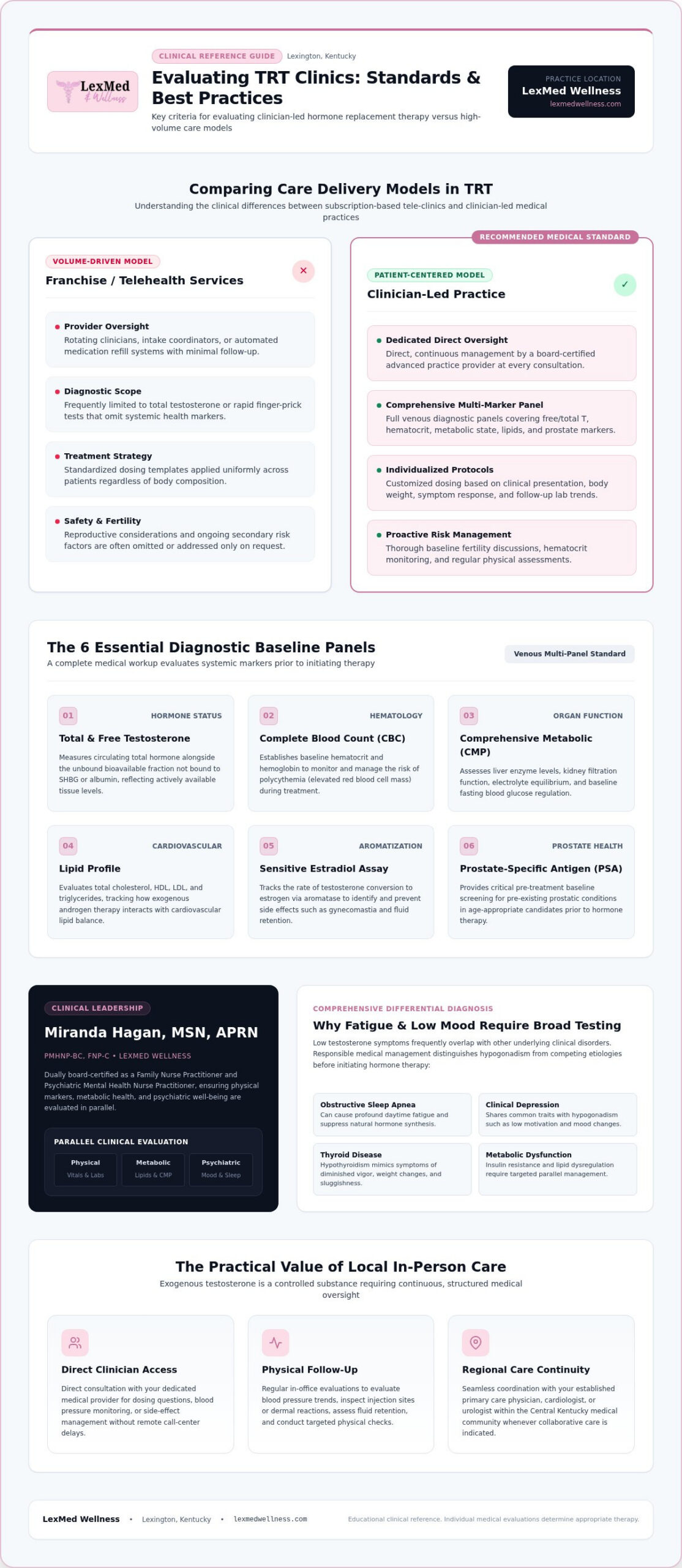
At LexMed Wellness in Lexington, patient evaluations and care plans are managed directly by Miranda Hagan, MSN, APRN, PMHNP-BC, FNP-C. Working with a dually board-certified family nurse practitioner and psychiatric mental health nurse practitioner ensures that physical health, metabolic markers, and psychiatric well-being are all evaluated in parallel. A provider with advanced diagnostic training evaluates your hormone levels within the broader context of your cardiovascular risk profile, mental health, current medications, and past medical history.
Comprehensive Diagnostic Workups vs. Abbreviated Testing
A legitimate clinical evaluation requires more than an isolated total testosterone check or a 15-minute finger-prick test. Total testosterone alone does not provide a complete clinical picture. High-quality care relies on a broad diagnostic panel before any clinical decision is made.
When selecting a clinic, confirm that their initial diagnostic testing includes:
- Total and Free Testosterone: Total testosterone measures all circulating hormone in the bloodstream, while free (and bioavailable) testosterone reflects the portion unbound to sex hormone-binding globulin (SHBG) and albumin, which is actively available to tissues.
- Complete Blood Count (CBC): Establishes baseline hematocrit and hemoglobin levels, which must be monitored regularly during therapy to minimize risks associated with polycythemia (elevated red blood cell mass).
- Comprehensive Metabolic Panel (CMP): Evaluates baseline kidney and liver function, as well as electrolyte and blood glucose regulation.
- Lipid Profile: Measures total cholesterol, HDL, LDL, and triglycerides, as exogenous hormones can influence cardiovascular lipid balances.
- Estradiol (Sensitive Assay): Monitors the rate at which testosterone converts to estrogen via aromatization, helping prevent symptoms such as gynecomastia or fluid retention.
- Prostate-Specific Antigen (PSA): Screens for pre-existing prostatic conditions in age-appropriate men prior to initiating treatment.
The Practical Advantages of Local, In-Person Care
While mail-order subscriptions and national telehealth companies offer convenience, they often struggle to provide the continuity of care necessary for safe, long-term hormone therapy. Exogenous testosterone is a controlled substance that carries distinct clinical risks requiring routine physical evaluations and regular blood monitoring.
Choosing an established local practice such as LexMed Wellness provides distinct clinical advantages:
- Direct Provider Access: If you experience unexpected side effects, dosing questions, or blood pressure changes, you can consult with your clinician directly rather than submitting support tickets to a remote call center.
- Consistent Physical Follow-Up: Routine in-person evaluations allow your provider to monitor blood pressure, assess injection sites or skin reactions, evaluate fluid status, and perform appropriate physical examinations.
- Informed Local Continuity: A local clinician understands regional healthcare networks, facilitating coordination with your primary care physician, cardiologist, or urologist whenever specialized collaboration is necessary.
Objective Clinic Comparison Checklist
Before committing to a care plan, consider how candidate clinics align with established medical standards:
| Evaluation Criteria | High-Volume / Franchise Model | Clinician-Led Medical Practice |
|---|---|---|
| Provider Oversight | Rotating clinicians, intake coordinators, or automated approvals | Consistent oversight by a dedicated, board-certified healthcare provider |
| Diagnostic Scope | Often limited to total testosterone or rapid screenings | Comprehensive multi-marker venous panels (free T, CBC, CMP, PSA, lipids) |
| Treatment Plans | Standardized dosing protocols applied uniformly across patients | Customized dosing based on clinical symptoms, body weight, and lab response |
| Fertility Discussion | Frequently omitted or addressed only upon direct patient request | Addressed upfront, discussing impacts on spermatogenesis and alternatives |
| Follow-Up Cadence | Infrequent, automated, or patient-directed testing | Scheduled lab evaluations at 6 to 12 weeks, followed by regular routine reviews |
| Pricing & Billing | Often bundled into rigid, long-term recurring subscriptions | Transparent fee schedules for consultations, labs, and medical management |
The Clinical Evaluation: What to Expect During an Assessment
A reputable evaluation for testosterone replacement therapy in Lexington, KY follows an established diagnostic framework to confirm that treatment is medically indicated, clinically appropriate, and safe.
- Comprehensive Medical History: Your clinician reviews your personal health history, family medical history (particularly cardiovascular events and prostate health), current prescription medications, supplement intake, and past surgical procedures.
- Detailed Symptom Review: Low testosterone produces non-specific symptoms that can easily be conflated with other medical issues. Your clinician explores the onset, severity, and duration of symptoms including chronic fatigue, changes in body composition, cognitive fog, mood changes, and shifts in erectile function or sexual desire.
- Diagnostic Laboratory Testing: Blood draws are scheduled during the morning hours (typically between 7:00 AM and 10:00 AM), when endogenous testosterone production peaks. Clinical guidelines recommend at least two separate morning blood draws confirming low levels before formalizing a diagnosis of hypogonadism.
- Physical Examination and Baseline Screening: The clinician measures baseline vital signs—paying close attention to blood pressure—and screens for physical indicators of endocrine disruption or other underlying pathology.
- Collaborative Treatment Consultation: Once lab results are finalized, the clinician reviews the findings in detail with you. If hypogonadism is diagnosed and no contraindications exist, your provider discusses available administration routes (such as intramuscular injections or topical preparations), explains realistic outcomes, details potential adverse effects, and outlines the mandatory monitoring schedule.
Diagnostic Testing vs. Basic Screens: Understanding the Biomarkers
One common issue in hormone management is relying solely on total testosterone to determine treatment candidacy. Testosterone circulates in the blood in two primary forms: bound and unbound. Approximately 98% of circulating testosterone is bound to proteins—principally sex hormone-binding globulin (SHBG) and albumin. Only the remaining unbound portion (free testosterone) and weakly bound portion (bioavailable testosterone) are easily accessible to biological receptors.
In practice, a patient may exhibit a total testosterone level within standard laboratory reference ranges while having abnormally high SHBG, leading to low bioavailable testosterone and symptomatic hypogonadism. Conversely, a patient with low SHBG may present with low total testosterone but adequate free testosterone. Relying solely on a basic screen overlooks these nuances, leading to potential misdiagnoses.
Furthermore, evaluating baseline red blood cell parameters through a CBC is essential. Exogenous testosterone stimulates erythropoietin production in the kidneys, which can increase red blood cell mass. Having accurate baseline hematocrit and hemoglobin measurements ensures that any therapy-induced increases can be managed safely before they lead to elevated blood viscosity.
Evaluating Overlapping Medical Conditions
Fatigue, low mood, and decreased motivation are not exclusive to low testosterone. An experienced provider evaluates whether other medical conditions are contributing to or causing your symptoms. Common conditions that mimic hypogonadism include:
- Obstructive Sleep Apnea (OSA): Disrupted sleep architecture suppresses nighttime LH (luteinizing hormone) pulses, lowering natural testosterone synthesis while causing daytime exhaustion. Prescribing TRT to an undiagnosed sleep apnea patient can exacerbate airway obstruction and accelerate hematocrit elevation.
- Thyroid Disorders: Both hypothyroidism and hyperthyroidism significantly alter metabolism, energy levels, and mood, and hypothyroidism frequently elevates circulating SHBG.
- Metabolic Syndrome and Type 2 Diabetes: Elevated visceral adiposity and insulin resistance correlate strongly with suppressed testosterone production. In these cases, lifestyle interventions or metabolic management may be recommended alongside or prior to hormone therapy.
- Chronic Psychological Stress and Depression: Elevated cortisol and dysregulated hypothalamic-pituitary-adrenal (HPA) axis function suppress gonadotropin-releasing hormone (GnRH), reducing downstream testosterone production.
Patients seeking care at our men’s health clinic in Lexington, KY receive a thorough clinical workup to ensure symptoms are not treated with hormone replacement when a different underlying diagnosis requires attention.
Considerations for Metabolic Health and Additional Therapies
While testosterone plays an important role in metabolism, muscle mass maintenance, and energy balance, hormone replacement is not a standalone weight loss intervention. At LexMed Wellness, we treat metabolic health, weight management, and endocrine function as distinct clinical concerns that can be addressed independently or in parallel when medically appropriate.
Addressing Metabolic Health and Weight Management
Excess visceral adiposity contains high concentrations of the aromatase enzyme, which converts circulating testosterone into estradiol. In men with significant adiposity, this enzymatic conversion can create a feedback loop: lower circulating testosterone contributes to decreased muscle mass and reduced energy expenditure, while increased aromatase activity suppresses the hypothalamic-pituitary-gonadal axis.
While restoring physiologic testosterone levels can support lean muscle mass retention and improve energy for physical activity, it does not replace nutritional interventions, structured exercise, or targeted metabolic therapy. For patients presenting with obesity or metabolic syndrome alongside hormone concerns, our practice provides structured medical weight loss in Lexington, KY. Medical weight management involves physician-supervised lifestyle modifications, laboratory metabolic tracking, and, when clinically indicated, prescription treatments such as GLP-1 receptor agonists. These programs are managed as separate treatment pathways tailored to patient health profiles rather than automatic additions to hormone therapy.
Peptide Therapies as Separate Treatment Offerings
Peptide therapy has gained significant attention in modern health discussions, but its clinical utility should be understood clearly. Peptides are specific chains of amino acids that act as signaling molecules within biological pathways, influencing processes like tissue repair, immune signaling, and natural growth hormone secretion.
Some commercial wellness clinics market peptide therapy as a mandatory companion to TRT or make broad claims regarding anti-aging and cellular rejuvenation. In our practice, peptide therapy in Lexington, KY is offered as an independent, elective clinical service based on specific patient health goals. Peptides are not standard or required components of testosterone replacement therapy. When utilized, peptide therapies are prescribed selectively, relying on clinical safety profiles and individualized health discussions rather than generalized wellness claims.
Ongoing Monitoring, Safety Protocols, and Risk Management
Initiating testosterone replacement therapy is a medical commitment requiring consistent monitoring. Exogenous testosterone alters several homeostatic systems, making routine clinical follow-up vital to minimizing adverse outcomes.
Managing Cardiovascular and Hematologic Safety
One of the primary laboratory concerns associated with TRT is secondary erythrocytosis—an increase in red blood cell volume. When hematocrit levels rise significantly (frequently defined clinically as exceeding 52% to 54%), blood viscosity increases, which may elevate cardiovascular strain.
A responsible clinical protocol requires regular complete blood counts (CBC). If hematocrit rises above acceptable clinical thresholds, your provider may adjust your testosterone dose, change the frequency of administration to minimize peak serum concentrations, or recommend therapeutic phlebotomy. Routine blood pressure screening is equally necessary, as fluid retention or increased vascular resistance can occur during early treatment phases.
Understanding the Impact on Fertility and Endocrine Feedback
When exogenous testosterone enters the body, the hypothalamus and pituitary gland detect the presence of circulating androgens. In response, they downregulate the release of luteinizing hormone (LH) and follicle-stimulating hormone (FSH). This reduction in gonadotropins signals the testes to reduce endogenous testosterone production and significantly slows or halts spermatogenesis.
For men who wish to preserve fertility or maintain future reproductive options, standard TRT may not be appropriate as an initial therapy. In such circumstances, a clinician should discuss alternative strategies—such as selective estrogen receptor modulators (SERMs) or human chorionic gonadotropin (hCG)—to encourage endogenous hormone production without suppressing fertility. A detailed fertility discussion must always take place before initiating treatment.
Prostate Health and Baseline Surveillance
Current clinical research has refuted the historical belief that testosterone therapy causes prostate cancer. However, exogenous androgens can stimulate the growth of pre-existing, androgen-sensitive prostate malignancies. For this reason, baseline PSA testing and clinical risk assessments are mandatory before beginning therapy in age-appropriate individuals. Ongoing monitoring protocols include periodic PSA measurements to detect any abnormal velocity or elevation that warrants referral to a urologist.
Frequently Asked Questions About Testosterone Replacement
Do I need a referral from my primary care doctor to schedule an evaluation?
No, a physician referral is generally not required to schedule a clinical consultation at LexMed Wellness. However, we encourage transparency across your entire healthcare team. With your consent, we can share lab results and treatment plans with your primary care provider to ensure cohesive, well-coordinated care.
How does a clinician determine if I am a candidate for TRT?
Candidacy is established through an objective diagnostic process rather than subjective feelings alone. A patient must present with consistent clinical symptoms of androgen deficiency alongside at least two separate morning blood draws demonstrating sub-therapeutic free or total testosterone levels. The clinician must also rule out contraindications—such as uncontrolled sleep apnea, severe erythrocytosis, active prostate cancer, or plans for near-term conception.
What are the most common potential side effects of testosterone replacement?
Potential side effects vary based on individual physiology, dosage, and delivery route. Commonly monitored considerations include mild acne, fluid retention, testicular atrophy, increased red blood cell count (elevated hematocrit), changes in lipid profiles, and gynecomastia related to estrogen conversion. These potential effects underscore the necessity of regular clinical monitoring and dosage adjustments.
How often is follow-up blood work required?
During the initial phase of therapy, lab work is typically repeated between 6 and 12 weeks after starting treatment or following any significant dosage adjustment. This allows your clinician to assess your physiological response and ensure markers remain within safe limits. Once a stable, therapeutic regimen is established and symptoms are managed, lab panels are typically conducted every 6 to 12 months, or sooner if clinical circumstances change.
Can TRT be discontinued once started?
Yes, testosterone replacement therapy can be discontinued under medical supervision. However, because exogenous testosterone suppresses natural production, abruptly stopping treatment will lead to a temporary drop in serum levels, often resulting in a return of baseline fatigue and hypogonadal symptoms. In these scenarios, a healthcare provider may prescribe a short-term post-therapy medical protocol to support the natural recovery of your hypothalamic-pituitary-gonadal axis.
How should I prepare for my initial lab draw?
Because testosterone levels naturally fluctuate and peak in the early hours of the day, your blood sample should be collected between 7:00 AM and 10:00 AM. Fasting for 8 to 12 hours prior to the blood draw is often recommended to ensure accurate evaluation of your lipid panel and glucose markers. You should also ensure you are well-hydrated, as dehydration can artificially skew hematocrit and kidney function readings.
Professional Men’s Hormone Care in Lexington
Choosing a provider for hormone replacement therapy is a significant healthcare decision. Rather than relying on rigid protocols or generic subscription services, effective medical care relies on thorough diagnostic testing, a complete understanding of your broader health, and attentive clinical oversight.
If you are experiencing persistent symptoms of low testosterone and want an objective, evidence-based assessment, we invite you to consult with our medical team. LexMed Wellness provides comprehensive diagnostic workups and customized testosterone replacement therapy in Lexington, KY. Contact our clinic today to schedule your in-person clinical evaluation.