

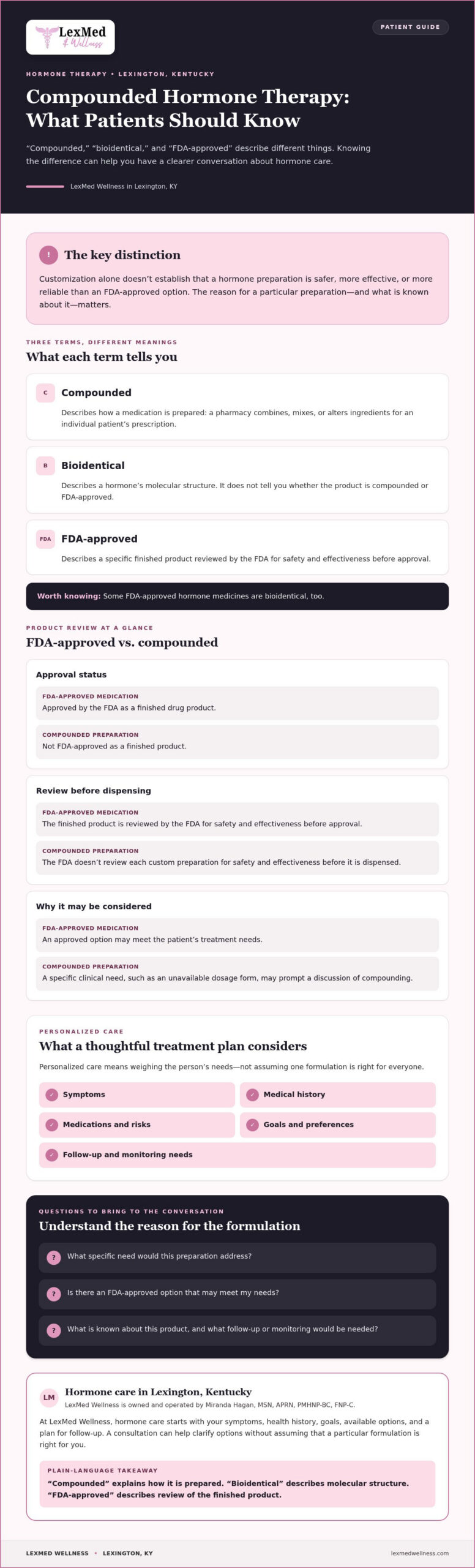
If you’re looking into compounded hormone therapy in Lexington, KY, you may be wondering whether a custom-mixed prescription is more personal, safer, or more effective. As I explain to patients at LexMed & Wellness, those terms are not interchangeable: compounded describes how a medication is prepared, bioidentical describes a hormone’s molecular structure, and FDA-approved describes a specific product reviewed by the FDA. Some FDA-approved hormone medicines are bioidentical, too.
It’s understandable to want treatment that fits your symptoms, health history, and preferences. The right starting point is a careful conversation about why a particular preparation is being considered, what is known about it, and whether an FDA-approved option may meet your needs. In this guide, I’ll walk through those distinctions and the questions I encourage patients from Lexington and nearby Central Kentucky communities to ask.
I’m Miranda Hagan, MSN, APRN, PMHNP-BC, FNP-C, and I own and operate LexMed & Wellness in Lexington, Kentucky. When I meet with someone about hormone care, I start with the person—not a preferred formulation. We review symptoms, medical history, goals, available options, and an appropriate plan for follow-up and monitoring.
Key Takeaways About Compounded Hormone Therapy in Lexington, KY
- “Compounded,” “bioidentical,” and “FDA-approved” describe different things; a customized preparation is not automatically safer or more effective.
- FDA-approved and compounded hormone medications differ in how the finished product is reviewed.
- Personalized hormone care should consider your symptoms, medical history, medications, risks, goals, and follow-up needs.
- A consultation with LexMed & Wellness in Lexington can help you understand available options without assuming a particular formulation is right for you.
What Does Compounded Hormone Therapy Mean for Lexington Patients?
Compounded hormone therapy is prepared by a pharmacy to meet an individual patient’s prescription. The term describes how a medication is made, not proof that it is safer, more natural, or clinically better than a commercially manufactured option. For people researching compounded hormone therapy lexington ky, that distinction is a useful starting point.
What does the word compounded mean in hormone care?
Compounding generally involves combining, mixing, or altering ingredients to prepare a medication for a patient’s prescription. The preparation may use familiar hormone ingredients and doesn’t necessarily involve a unique ingredient or delivery method. Unlike an FDA-approved, commercially manufactured drug, a compounded preparation isn’t reviewed and approved by the FDA as a finished product before it is dispensed.
“Bioidentical” refers to a hormone’s molecular structure, not whether it is compounded or FDA-approved. Some approved products contain bioidentical hormones, while custom-compounded preparations are a separate category. The FDA, the American College of Obstetricians and Gynecologists (ACOG), and The Menopause Society all distinguish product approval and available evidence from marketing descriptions such as “natural” or “bioidentical.”
Why might patients ask about compounded hormones?
Patients may ask about a particular dose, combination, or form, or whether a preparation can avoid an ingredient they cannot use. Those preferences are worth discussing, but customization alone doesn’t establish a safety or effectiveness advantage. The reason for compounding should relate to the patient’s medical situation, especially if an FDA-approved option may be available.
LexMed & Wellness offers individualized hormone replacement therapy in Lexington, Kentucky. The clinic’s available service information doesn’t confirm that compounded prescriptions are offered, and a consultation doesn’t guarantee a particular medication or formulation. Patients exploring menopause care can learn about the clinic’s menopause treatment in Lexington and discuss which options may fit their health history and goals.
How Does Compounded Hormone Therapy Differ From FDA-Approved Treatment?
The main difference is product review. FDA-approved hormone medications are reviewed as finished products for safety and effectiveness. Compounded drugs aren’t FDA-approved as finished products, and the FDA doesn’t review each custom preparation before it is dispensed. That distinction doesn’t mean every compounded prescription is unsuitable, but customization alone doesn’t establish better results or more reliable dosing.
| Consideration | FDA-approved medication | Compounded preparation |
|---|---|---|
| Approval status | Approved by the FDA as a finished drug product. | Not FDA-approved as a finished product. |
| Product review | Reviewed by the FDA for safety and effectiveness before approval. | Not reviewed by the FDA for safety and effectiveness before dispensing. |
| Why it may be considered | An approved option may meet the patient’s treatment needs. | A specific clinical need, such as an unavailable dosage form, may prompt a discussion of compounding. |
What does FDA approval mean for a hormone medication?
FDA approval means the agency has reviewed evidence for that specific product. It doesn’t mean a medication is risk-free or right for every patient. The FDA, ACOG, and The Menopause Society provide patient and clinician guidance that can help distinguish approved menopause medicines from compounded products.
Does a personalized formulation mean a better treatment?
Personalized care means weighing symptoms, medical history, risks, and goals. It doesn’t by itself show that a particular compounded formulation works better, is safer, or delivers more consistent doses than an approved option. For people researching compounded hormone therapy lexington ky, ask what specific need the proposed preparation addresses and what alternatives are available.
LexMed & Wellness offers individualized hormone replacement therapy in Lexington, Kentucky. To explore the clinic’s menopause hormone therapy options, patients can discuss their goals and available treatments without assuming a particular formulation will be prescribed.
How Is Personalized Hormone Therapy Planned and Monitored?
Personalized hormone therapy should be based on your symptoms, medical history, medications, examination findings, risk factors, and treatment goals—not simply on a request for a compounded prescription. Before an appointment in Lexington or nearby Central Kentucky, note when your symptoms began and how they affect sleep, work, relationships, or daily life. Symptoms such as hot flashes, perimenopause changes, and menopause-related weight gain can have overlapping causes, so testing should answer a specific clinical question rather than follow the same panel for everyone. You can also review our information on perimenopause treatment and menopause-related weight gain.
Which questions help clarify the clinical rationale?
If compounding is proposed, ask why it is being considered instead of an FDA-approved option and what specific need it is meant to address. Ask what evidence supports the formulation, what remains uncertain, and how its risks and possible medication interactions apply to you. Guidance from the FDA, ACOG, and The Menopause Society can provide useful context when you compare treatment claims with established evidence.
How should testing and monitoring be discussed?
There isn’t one lab panel that answers every hormone-care question. The choice of tests depends on your symptoms, history, examination, and the treatment being considered. Before starting any medication, clarify how progress and side effects will be reviewed, what monitoring is relevant, and what might prompt a change in the plan.
- What alternatives are available, including FDA-approved medications?
- Which risks or contraindications matter most in my case?
- How will we decide whether treatment is helping, and when will we reassess?
These questions can help patients researching compounded hormone therapy in Lexington, KY make an informed decision without assuming a particular medication is right for them. At LexMed & Wellness, I can discuss menopause hormone therapy options and how follow-up may be handled based on your individual plan.
Where Can I Discuss Hormone Therapy in Lexington, KY?
When you meet with me at LexMed & Wellness, we can start with what you’re experiencing and what you want to improve. We’ll review your health history, consider appropriate options, and talk through benefits, risks, alternatives, and monitoring. The goal is a plan that makes sense for your health—not a commitment to a particular medication or formulation.
What can patients expect from a local hormone-care discussion?
I’m Miranda Hagan, MSN, APRN, PMHNP-BC, FNP-C, and LexMed & Wellness is my Lexington, Kentucky practice. I take time to understand each patient’s concerns, symptoms, health background, and goals before discussing hormone therapy. If you are comparing compounded hormone therapy in Lexington, KY with FDA-approved options, we can review the differences and what may be appropriate to consider.
If menopause symptoms are part of your concern, start with our menopause treatment information for Lexington patients. You can also learn more about treatment considerations for hot flashes.
When should a patient seek individualized evaluation?
Consider arranging an evaluation if symptoms persist, disrupt sleep or daily activities, or leave you unsure what may be causing them. Hormone changes are one possible explanation, but symptoms can also have other causes. A clinician can review your history, medications, risk factors, and any relevant examination or testing before discussing whether hormone therapy fits your needs.
If you’re researching compounded hormone therapy lexington ky, bring questions about why a specific preparation is being considered, what alternatives exist, and how treatment would be monitored. LexMed & Wellness provides a local setting to discuss hormone replacement therapy options without presuming a compounded formulation will be available or recommended.
This article is for education only. It can’t diagnose a hormone condition or establish a patient-provider relationship; individual care requires a separate clinical evaluation.
Take the Next Step With a Lexington Hormone-Care Provider
Compounded hormone therapy is a customized preparation, not an automatic upgrade in safety or effectiveness. FDA-approved options and compounded preparations differ in how the finished product is reviewed. A thoughtful discussion considers your symptoms, medical history, risks, goals, available alternatives, and how progress will be monitored.
If you’re researching compounded hormone therapy in Lexington, KY, I invite you to bring your questions to LexMed & Wellness. I’m Miranda Hagan, MSN, APRN, PMHNP-BC, FNP-C, and I provide individualized hormone-care consultations in Lexington for patients from Central Kentucky. We can discuss what options are available and whether hormone therapy fits your situation.
When you’re ready, schedule a consultation with LexMed & Wellness to discuss hormone therapy in Lexington, KY. A conversation with a qualified provider is a practical place to review your symptoms, ask questions, and make an informed care decision.
Compounded Hormone Therapy Lexington KY FAQs
Is compounded hormone therapy FDA approved?
No. Compounded hormone medications aren’t FDA-approved as finished products, and the FDA doesn’t review each customized preparation for safety and effectiveness before it is dispensed. That differs from FDA-approved hormone medicines, which undergo product-specific review. Compounding pharmacies are subject to other oversight, but that doesn’t make a compounded preparation FDA-approved. If you’re considering one, ask what product is proposed and how its oversight differs from an approved alternative.
Is compounded hormone therapy safer or more natural than FDA-approved treatment?
No. “Bioidentical” describes a hormone’s molecular structure, not its approval status or safety. Some FDA-approved medications contain bioidentical hormones. A customized preparation should be considered based on your clinical situation and the available evidence, not on the word “natural” alone.
Why might a clinician consider compounded hormone therapy?
A clinician might discuss compounding when a patient has a specific need that an available FDA-approved product doesn’t meet, such as a required dosage form that isn’t commercially available or an ingredient allergy. The reason should relate to the person’s clinical situation. Ask why compounding is being considered, what approved alternatives exist, and what is known and uncertain about the proposed preparation.
Where can I discuss compounded hormone therapy in Lexington, KY?
You can discuss hormone therapy options with Miranda Hagan, MSN, APRN, PMHNP-BC, FNP-C, at LexMed & Wellness in Lexington. Bring your symptoms, medication list, health history, risk concerns, and treatment goals. Ask why compounding is being considered, what alternatives exist, and how follow-up will be handled. Patients from Lexington, Georgetown, Nicholasville, Louisville, Winchester, and Danville can contact the practice to confirm available services.